How to hook viewers in the first 3 seconds
Viewers decide whether to keep watching almost instantly — long before you get to the good part. Here's what to say and show in those first seconds so people don't swipe, and which hooks work for talking videos.
Why the first seconds decide everything
In a Reels feed the next video is always one flick away. Viewers don't know you and have no reason to wait while you warm up. If the opening promises nothing, they leave — even if great advice was coming next.
So the start of your video isn't an intro, it's its own job. That's the hook: the line and the picture that grab attention and give people a reason to stay.
Types of hooks — with examples
A good hook promises something useful or an intriguing answer. These types work well in talking videos:
- A mistake: “Three mistakes that make people skip your Reels”.
- A result: “How I film a week of videos in one evening”.
- A question viewers already ask themselves: “Why is your skin flaky even when you moisturize?”
- Pushing back on common wisdom: “Running on an empty stomach isn't the best idea”.
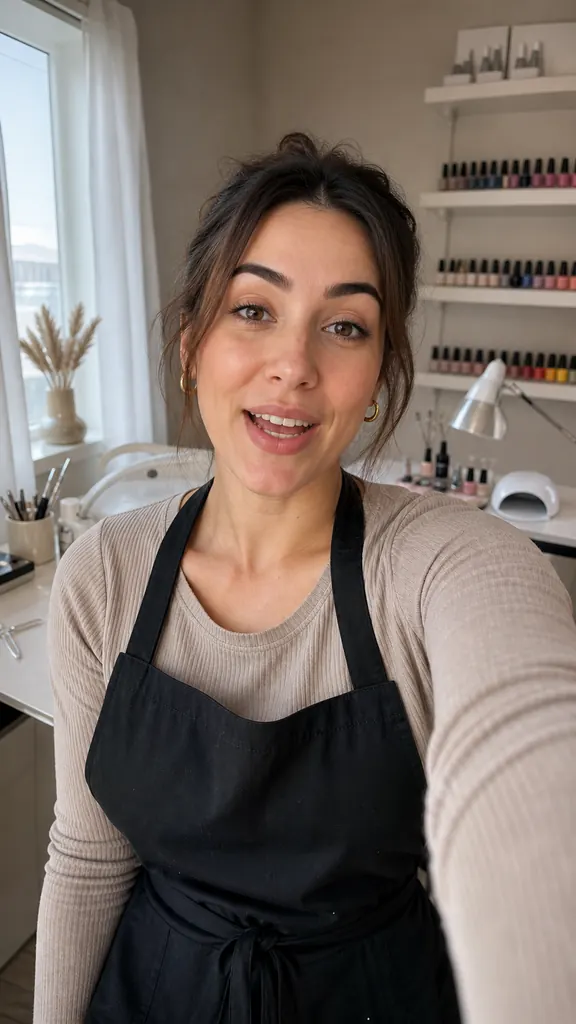
- Calling out specific people: “If you're a nail artist who's scared of the camera, this is for you”.
- A concrete number: “One trick that cuts editing time in half”.
The golden rule: your hook has to be true. If the video doesn't deliver on its opening line, viewers remember — and swipe past you faster next time.
Open with the point
The easiest way to lose a viewer is a long warm-up: “Hey everyone, my name is…”, “Today I want to talk about…”, “I've been meaning to film this for ages…”. You can cut all of it and lose nothing.
Quick test: if you delete your first line and the video loses nothing, that line doesn't belong there. Say hi and introduce yourself later, or let your profile do it.
On-screen text backs up the hook
Lots of people watch on mute, so your hook should be written as well as spoken. A short line of text over the frame in the first seconds is a second chance to catch someone who hasn't turned the sound on.
- a few words that can be read at a glance;
- big and high-contrast, not over your face;
- the same idea as your first line — text and voice shouldn't compete.
The first seconds are visual too
Even a strong line gets lost if the video opens with silence, a glance off to the side or a hand reaching for the record button. Start talking right away, look into the lens and bring energy from the first word.
- no pause before the first word;
- your face close up and well lit;
- a confident first line — not whispered, not on an in-breath;
- nothing in the frame that pulls attention away from you.
How to come up with a hook when you're stuck
Film the whole video first, then rewatch it and find your strongest line. Often it's the takeaway, a surprising number or a mistake you break down in the middle. Put that first — even if you filmed it last.
It also helps to film two or three different openings and compare. A hook that sounds natural coming from you beats a memorized “salesy” line.
How to do it in Dubl
- Record your takesFilm with the teleprompter or add videos from your gallery — the AI learns from your speech what the video is about.
- Get a hook stickerThe AI writes a short hook from your speech — up to 32 characters — and places it over the frame at the start.
- Get your strongest line firstThe AI orders your lines by meaning and opens with the strongest one, even if you filmed it last.
- Decide what staysHook, stickers and captions each have their own switch in caption settings.